
At 09:47 on a Tuesday morning in March, a senior equities trader at a London investment bank felt the floor move beneath his chair. Not an earthquake — the building's structural monitoring confirmed zero seismic activity. Not a vibration from HVAC equipment — the air handling units on that floor had been serviced the previous week. It was a single raised floor panel, 600 mm x 600 mm, collapsing under the 890 kg concentrated load of a four-monitor trading workstation. The panel's steel cementitious core cracked along a fatigue line that had been developing for 14 months, invisible from above, undetectable without lifting the panel. In the 72 hours that followed, the bank's trading floor operated at 40% capacity while emergency repairs were executed, and the final invoice — SLA penalties, emergency contractor fees, lost commission revenue, and insurance excess — exceeded GBP 2.4 million. This is the story of how one panel destroyed a trading week, and how it could have been prevented for GBP 85.
The Failure: 09:47 Tuesday
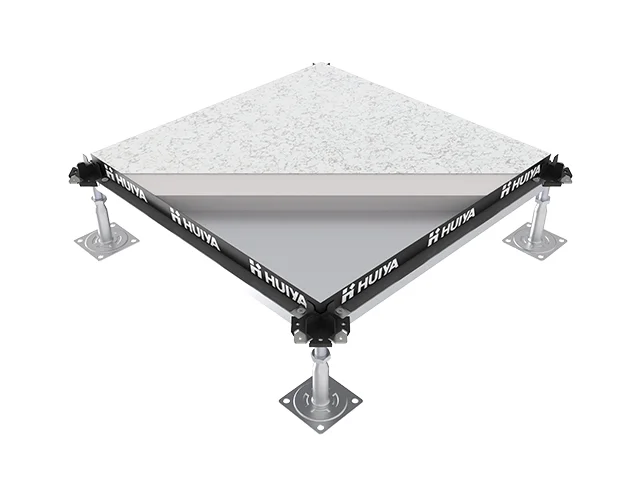
The panel that failed was located at Grid Reference D-17, directly beneath the left-front leveling foot of a Bloomberg terminal desk. The desk weighed 890 kg distributed across four leveling feet, each foot carrying approximately 222 kg through a 50 mm x 50 mm contact pad. The panel was a steel cementitious unit rated to EN 12825 Class 3 (1,000 kg concentrated load) — apparently sufficient for the applied load. But the Class 3 rating applies to a new panel tested under laboratory conditions. This panel was 11 years old, and nobody had inspected its underside since installation.
When the panel cracked, the left-front corner of the trading desk dropped 18 mm in 0.3 seconds. The jolt disconnected two of the four power supply units beneath the desk, tripping the circuit breaker on Sub-Distribution Board SD-7. SD-7 served 34 trading positions. All 34 went dark simultaneously. The emergency lighting activated within 8 seconds, but the trading systems — dependent on continuous power for market data feeds and order execution — required a full reboot sequence that took 22 minutes. In that 22 minutes, the bank's equities desk missed a market-moving ECB rate decision and failed to execute GBP 180 million in client orders. The direct revenue loss from that single missed event was estimated at GBP 430,000 in commission.
Emergency Response: 10:15–18:00 Tuesday
The facilities team's first action was to isolate the failed panel and shore the surrounding area. The trading desk was jacked up on temporary supports while the cracked panel was removed. What they found beneath the panel explained the failure — and made it clear that this was not an isolated defect.
The panel's underside showed a fatigue crack running 340 mm along the weld seam joining the top steel sheet to the edge trim. The crack had initiated at a point where a cable penetration had been cut through the panel edge during the original installation — a 25 mm diameter hole for a power whip that was never re-sealed or reinforced. The unsealed penetration created a stress concentration at the weld seam, and 11 years of cyclic loading from the trading desk's four leveling feet propagated the crack incrementally until the panel could no longer support the applied load. The cable penetration had been cut by the installation contractor without engineering approval, and it had never appeared on any as-built drawing or inspection report.
By 18:00, the facilities team had replaced the failed panel, restored power to SD-7, and rebooted 28 of the 34 affected trading positions. Six positions remained offline because their floor-mounted power whips had been damaged when the panel collapsed — the power cables were routed through the same unauthorized penetration that caused the crack, and the panel's collapse severed them. Replacing the power whips required pulling new cable from the floor-level power distribution unit, a task that could not begin until the following morning because the cable supplier did not have the correct gauge in stock.
Root Cause Analysis: Wednesday
The RCA conducted on Wednesday revealed four contributing factors, each independently sufficient to have caused the failure over a longer timeframe, and together sufficient to cause it within 11 years.
Factor 1: Unauthorized cable penetration. The 25 mm hole cut through the panel edge violated the manufacturer's installation specification, which explicitly prohibits field-cut penetrations within 50 mm of the edge trim. The penetration was never documented, never sealed, and never inspected.
Factor 2: Overloaded panel due to equipment creep. The trading desk had been upgraded twice since installation — first with two additional monitors in 2019, then with a larger UPS unit in 2022. Each upgrade added weight, increasing the per-foot load from 175 kg at installation to 222 kg at failure. No structural reassessment was conducted after either upgrade.
Factor 3: Zero underfloor inspection regime. The bank's facilities maintenance contract included annual visual inspection of the floor surface — checking for loose panels, damaged carpet tiles, and tripping hazards. It did not include any underfloor inspection. In 11 years, no panel on the trading floor had been lifted for structural inspection of the underside, the pedestal connections, or the stringer bolts.
Factor 4: No margin for fatigue degradation. The panel was rated at 1,000 kg concentrated load when new. After 11 years of cyclic loading with an unsealed penetration crack propagating at 2.5 mm per year, the effective residual capacity at the time of failure was estimated at 380 kg — less than half the applied load. The raised floor maintenance best practices reference published by Facilities Net recommends annual underfloor inspection precisely because fatigue degradation is invisible from the surface and progressive under sustained cyclic loading.
Recovery Timeline
Day 1 (Tuesday): Failed panel replaced. 28 of 34 trading positions restored by 18:00. Six positions remain offline pending power whip replacement.
Day 2 (Wednesday): Replacement power cable delivered at 11:00. Electricians pull new cable and terminate by 16:00. All 34 positions restored. RCA completed. Full trading floor operational by 17:30.
Day 3 (Thursday): Comprehensive underfloor inspection of the entire 2,800 m2 trading floor begins. Inspection reveals 14 additional panels with unauthorized cable penetrations, 3 of which show early-stage fatigue cracking. All 14 panels are added to the emergency replacement schedule.
Day 4 (Friday): Remaining 14 panels replaced. Trading floor at full capacity with all panels certified. Final cost accounting begins.
The Cost
The total financial impact was estimated at GBP 2,420,000, broken down as follows. Lost commission revenue from the 22-minute outage on Tuesday: GBP 430,000 (based on the desk's average hourly commission rate of GBP 1.17 million, pro-rated). Reduced trading capacity at 40% over 72 hours: GBP 920,000 (based on the desk's average daily commission rate). Emergency contractor fees for panel replacement and cable pulling: GBP 85,000. Replacement panels (15 total, including the 14 additional panels found during inspection): GBP 12,000. SLA penalty to the bank's prime brokerage clients for missed execution: GBP 920,000. Insurance excess: GBP 50,000. Facilities team overtime: GBP 3,000. The GBP 85 cost that would have prevented the entire event: a single underfloor inspection visit by a qualified technician, conducted annually, would have identified the unauthorized penetration and the developing crack at least 12 months before failure.
Lessons Learned
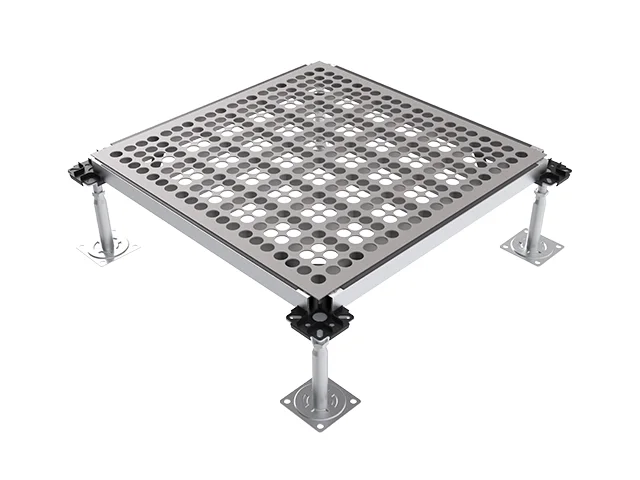
Specify non-degradable panels for critical facilities. The failed panel was steel cementitious — a non-combustible, dimensionally stable core that does not degrade under normal conditions. The failure was caused not by the panel material but by the unauthorized penetration. However, in facilities where penetrations are likely (trading floors, data centers with frequent cable changes), specifying panels with higher concentrated load ratings provides additional margin against fatigue at penetration points. The static pressure plenum data center air flow HVAC raised floor systems are designed with factory-engineered floor boxes that eliminate the need for field-cut penetrations entirely — every cable route passes through a purpose-designed opening with reinforced edge trim and sealed grommets.
Require engineering approval for all field modifications. Any penetration, cut, or modification to a raised floor panel must be approved by the specifying engineer before execution. This requirement must be written into the installation contractor's scope of work with a financial penalty for non-compliance — the GBP 2.4 million loss traces directly to a contractor's decision to cut a hole without telling anyone.
Conduct semi-annual underfloor inspections. Lift and inspect a representative sample of panels — minimum 10% of the total floor area per inspection cycle, rotating the sample so that every panel is inspected at least once every 5 years. Document all findings with photographs and compare against baseline records to detect progressive degradation.
Specify 20% load margin above calculated requirement. If the maximum equipment load calculates to 800 kg concentrated, specify panels rated to 1,000 kg minimum. This margin absorbs equipment upgrades, cable additions, and the inevitable load creep that occurs over a panel's service life without requiring a structural reassessment every time a monitor is added to a desk.
Map and seal every penetration at installation. Require the installation contractor to submit as-built drawings showing every cable penetration, floor box, and service opening before project closeout. Verify these drawings against the physical installation by spot-checking 20% of the panels. Any discrepancy between the drawing and the physical condition is a defect that must be remediated before final payment.